
We're BAAACCCKKK!
Tariffs 2: A Perhaps Unwanted Sequel - Part 1 - The Macro Impact and Consumer Perception

Tariffs Today and Tomorrow: The Sequel
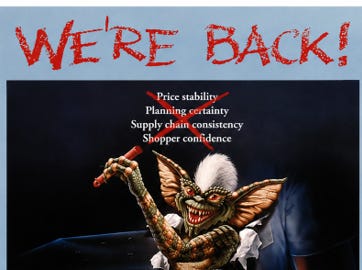
Like many unwanted sequels, the latest chapter in US tariff policy feels a little like Gremlins 2…a movie I moderately dreaded (I saw NO reason to try and improve on the original - a near perfect work of art!) and did not enjoy. It is a little scarier than the first one, not as fun, missing the novelty and a movie that made me wonder why it was made.
But here we are.
In this piece we break out what’s actually happening and how tariffs change the mindset of the shopper
The latest series of tariff changes creates a challenge that we think of as a three-layer cake.
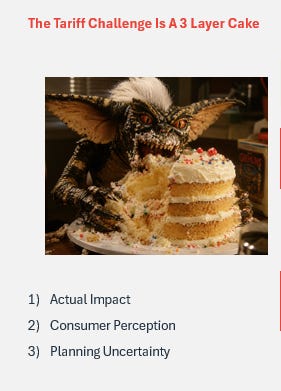
The first layer is the actual economic impact.
The second is consumer perception.
The third is business planning uncertainty.
Each layer matters. But they do not matter in the same way, and the combination of the three is potentially more disruptive than any one of them on its own.
So let’s take them in order.
First, what has actually changed?
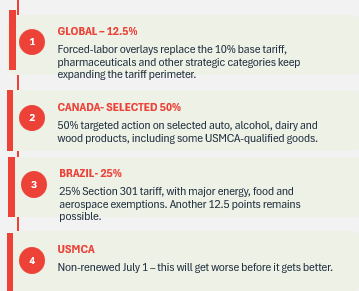
There are four broad elements in the current tariff picture.
The first and most significant is the return of something resembling a 12.5% global tariff rate through a tariff mechanism tied to forced labor. In effect, countries are being tariffed as a punitive measure for the forced labor used in the production of goods. Quantitatively, that has roughly the same impact as the earlier tariffs that the Supreme Court found unconstitutional.
The second issue is Canada. There are a variety of Canadian categories scheduled to face tariffs of 50% beginning August 19. For purposes of our model, we have included those tariffs as though they happen, simply to understand what the forecast might look like.
There is a decent chance that some or all of them do not happen. With the exception of dairy, many of the categories involved are not imported from Canada at enormous scale. But they are included in the model.
Third, Brazil has received a 25% tariff.
The fourth, and potentially most consequential over time, is the broader issue surrounding the USMCA and the trading relationship among the United States, Mexico and Canada.
We will come back to that, because it is central to the planning uncertainty layer.
Layer One: The New Tariff Math
Retail Cities has built a model that attempts to estimate the overall tariff rate by weighting tariffs by both country and import category.
Different categories of products come from different countries. A tariff on a country from which we import relatively little has a different economic impact from a tariff on China, Mexico or Canada. A tariff on a heavily imported category has a different impact from a tariff on something primarily made in the United States.
This is a model, not an exact number.
But it gives us an order of magnitude.
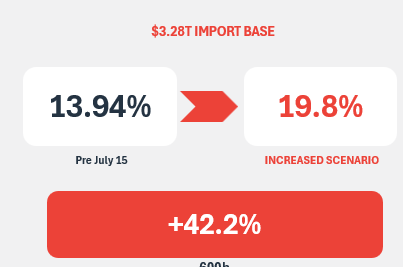
Across roughly $3.3 trillion in US imports, our estimate is that the effective tariff rate is now approximately 19.8%. That does not mean anyone is literally paying 19.8% on everything. The rate is different for every combination of country and category. But if you blended all the tariffs together into one weighted average, that is approximately where you would land.
That is a 42.2% increase from where tariffs stood before the Supreme Court overturned the earlier series of tariffs. Put another way, the effective rate is roughly 600 basis points higher.
But the impact on the overall US economy is probably not as large as the headline number initially makes it sound.
Why a 20% tariff does not create 20% inflation
When someone sees an average tariff rate approaching 20%, the immediate reaction is understandably: “Does this mean everything is about to become 20% more expensive?”
No.
The first reason is that not everything we buy in the United States is imported.
Approximately 40% of the physical goods purchased in the US are imported. If the effective tariff rate is 19.8%, that implies the cost of “stuff” is approximately 7.9% higher than it would have been without the tariffs, assuming full pass-through.
That is meaningful. But the second issue is that most of the US economy is not stuff.
Approximately 70% of what Americans consume is services. Housing, healthcare, education, financial services, restaurants, entertainment and a wide range of other activities are not immediately subject to tariffs in the way that imported furniture or electronics are.
That means only about 30% of the overall economy is directly tariff-susceptible in the short term.
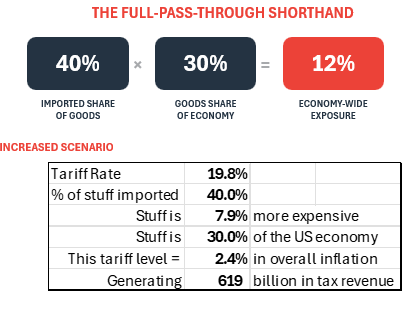
When you discount the 7.9% goods impact by the share of the economy that consists of goods, you get a potential CPI impact of roughly 2.4 percentage points, assuming every dollar of tariff cost is passed through to the consumer. That assumption is also unlikely. Based on what we have seen since the original Liberation Day tariffs, approximately half of the tariff increase appears to filter through into the consumer economy.
That produces an estimated CPI impact closer to 1.2 percentage points.
Is that a lot? Not exactly.
Is it the end of the world? No.
But it is approximately the gap between where inflation is in the United States and where the Federal Reserve would like it to be.
Without tariffs, there is a reasonable argument that US inflation would be much closer to 2% than to 4%. That would affect the Fed’s attitude toward monetary policy, capital investment and a wide range of other economic decisions.
The simplest way to think about this is that tariffs are functioning like a national sales tax of approximately 2% to 2.5%. Nobody wants to call it that because national sales taxes are unpopular. But functionally, a 2.5% sales tax, or a 2.5% VAT, is pretty close to what we are describing.
Layer Two: Consumers Hear “Tariffs” and Think “Inflation”
Now we move to the second layer of the cake - consumer perception. Consumer tracking data cited in the presentation shows that approximately 75% of consumers believe tariffs will raise prices.
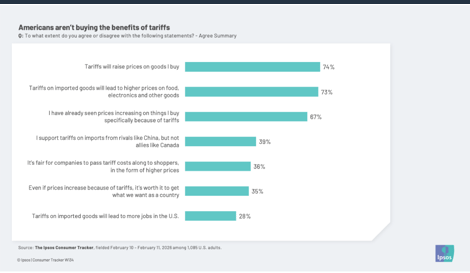
Approximately 73% believe tariffs will produce higher prices on food, electronics and other goods.
That question really should have been broken into separate categories.
It would be useful to know how many consumers correctly expect tariffs to meaningfully increase the price of electronics (which is happening), and how many expect the same impact on food, where the direct tariff effect is likely to be much more limited and other factors are driving inflation.
Simply put - when consumers hear the word “tariffs,” they think “inflation.”
And encouraging consumers to think about inflation may not be what the American economy needs at this particular moment.
Perception can become economically consequential even when it is not perfectly aligned with the underlying cost structure.
Consumers who expect prices to rise may change where they shop, what they buy, how much inventory they hold at home, which brands they trust and how they interpret every subsequent price increase.
That is where the tariff story becomes much more complicated than the mathematical CPI impact, especially when other factors such as oil prices, trucking costs and crop yields are making groceries actually more expensive.
3 Key Implications:
1) We need to be faster and smarter around understanding shopper price and value perception, and how the inflation narrative is shifting it. This is a tremendous use case for AI to either partner with great AI-powered analytic tools or use AI to triangulate real-time sentiment with pre-existing data sets to extrapolate predicted changes. Perception > reality, and reality > data - if your share drops by more than your “models” say it should based on the price gap that’s a problem with your model…reality isn’t wrong!
2) Inflation appears to be semi-permanent rather than transient and our category plans need to account for that. Particularly given how much pushback retailers are going to put on the next wave of pricing brands are trying to take (some have alreaddy put a VERY firm stake in the ground here) we need to understand where we have value gaps to close or value opportunities created by a competitor whose pricing has gone up more than ours.
3) Certain Volatility - most companies have “VUCA” kicking around in a slide deck somewhere - “Volatile, Uncertain, Complex, Ambiguous” - the world isn’t uncertain - it’s Certainly Volatile. Which of your work processes is worst designed for volatility? Fix it.